brand focus
2 minute read
How to date a Stone Island piece by the label — a decade-by-decade guide
Words by Heather June Coombs
The green edge gave way to the green-bordered badge. This is often the first identifier.
The Early Years: Massimo Osti and the Green Edge (1982-1987)
Dating Stone Island usually starts with the internal label. The first general release pieces, post-Tela Stella, carried a white care tag with a distinctive green stripe along its left edge. This is the hallmark of the original Massimo Osti era. The font was simple, blocky, and without frills. Crucially, ‘Made in Italy’ was prominent. Later in this period, a smaller white on black woven neck label also appeared, often with just 'Stone Island' and no further details. No Certilogo, no QR codes, just production basics.
The Green Badge Era (1988-1999)
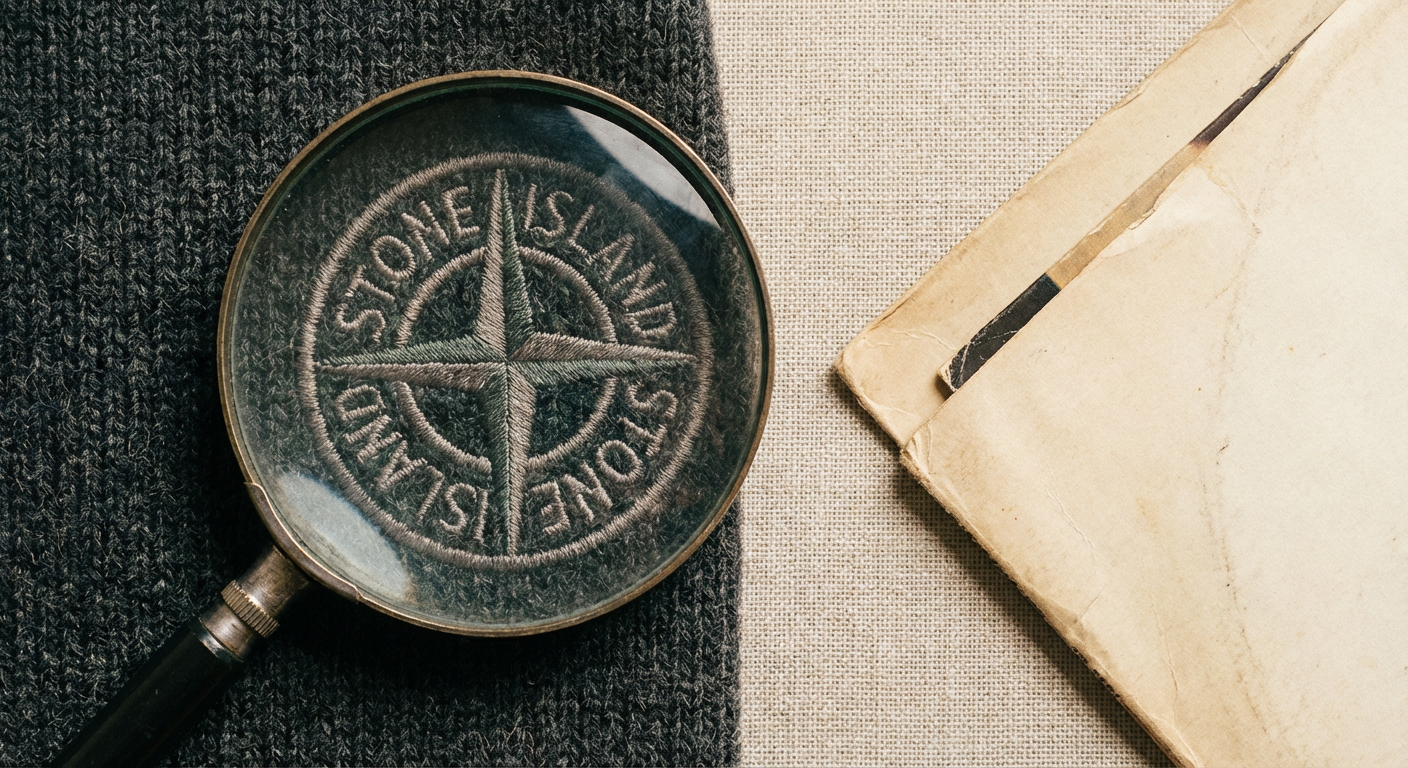
The green edge gave way to the green-bordered badge. This is often the first identifier. The compass logo, originally a separate embroidered piece stitched onto garments, became integrated into a woven patch. The green trim was the key differentiator. Internal care labels grew slightly, adding material composition and washing instructions. Fonts remained consistent with the previous decade. ‘Made in Italy’ was still standard, reflecting the brand’s entrenched domestic manufacturing. Specific lines like 'Marina' or 'Denims' would sometimes feature their own distinct internal tags.
The Millennial Shift: Art. Numbers and Certilogo (2000-2008)
The turn of the millennium brought significant changes. The green badge disappeared, replaced by the now-familiar yellow-and-green edged badge. More importantly for authentication, the Art. Number system became standard. This eight-digit code (e.g., 40154030/A) printed on the internal wash tag became the de facto identifier. The first two digits denote the season and year (e.g., 40 = A/W 2004, 41 = S/S 2004, etc.). The Art. Number allows for cross-referencing against Stone Island archives. In this period, Certilogo was introduced on some pieces, usually a red tab with a unique code for online verification, though its prevalence grew later.
Shop from this article

The Certilogo Standard and Font Evolution (2009-2017)
Certilogo became almost ubiquitous. If a piece from this era lacks a Certilogo QR or code, proceed with caution. The Art. Number system continued its role. The font on internal labels began to modernise, moving from the blocky, utilitarian style to a cleaner, more contemporary sans-serif. Country of origin remained predominantly Italy, but some specific ranges or accessories might state other EU countries. The woven neck label typically featured 'Stone Island' and the compass logo, without extraneous text.
Modern Era: Digital Integration and Global Production (2018-Present)
The current generation of labels is characterised by high-resolution printing, greater detail, and a continued reliance on digital verification. Certilogo is standard, often with a QR code for smartphone scanning. The Art. Number remains the core physical identifier. You will find a more diverse range of manufacturing locations listed, reflecting Stone Island's expanded production network beyond Italy, though Italy remains a primary hub. The typography is refined, clear, and consistent across all internal labels. Fabric innovation often sees specific fabric names, like 'Nylon Metal' or 'Membrana 3L TC', printed on dedicated smaller tags. When assessing any archive Stone Island piece, the label is the first point of contact. Understand its evolution, and you understand the garment's history. Discrepancies between the badge, the internal label, and the Art. Number are immediate red flags. Buy with knowledge.