outerwear
5 minute read
What to look for in a pre-owned Stone Island shell jacket — the complete buyer guide
Words by Heather June Coombs
A technical jacket with a perished membrane is not vintage character; it is a rain jacket that no longer works.
Buying a pre-owned Stone Island shell jacket is an exercise in inspecting fabric chemistry, not just checking for missing buttons. The Italian brand built its reputation on experimental dyeing and technical laminates. While those processes create unmatched surface textures when fresh, they age in highly specific ways. If you do not know what internal resin breakdown smells like or how to read an ART code, you will end up overpaying for a jacket that leaves white dust on your knitwear every time you put it on.
The core fabrics: what you are actually buying
Stone Island classifies shells by their base cloth and dye treatments. Knowing the difference between them tells you how the piece will hold up over a decade of wear.
David-TC begins as an industrial Japanese polyester and polyamide warp. The garments are sewn entirely before undergoing high-pressure garment dyeing at 130 degrees Celsius. This heat alters the structure of the fibres, giving David-TC an almost leather-like, dense hand feel. It is virtually bulletproof. Pre-owned examples rarely suffer catastrophic fabric failure, though you should check the high-friction points at the cuffs and hem for fraying.
Membrana 3L TC is a three-layer performance fabric consisting of a light nylon face, a breathable water-resistant membrane, and a superfine polyester backing. Because it is garment dyed without losing its technical barrier, it represents classic Carlo Rivetti-era engineering. However, it is far more fragile than David-TC. Pre-owned examples often suffer from internal delamination if washed improperly.
Crinkle Reps NY uses an uneven resin bath on the interior of a lightweight rep weave. When dyed, the resin resists the pigment unevenly, producing the signature crinkled appearance. It is a workhorse fabric, but heat is its enemy. If a previous owner put a Crinkle Reps jacket through a tumble dryer, the resin lining tightens, puckers artificially, and will never lay flat again.
Ghost O-Ventile pieces come from entirely organic, long-staple cotton woven so tightly that when the fibres get wet, they expand and seal the weave. No synthetic membranes, no coatings. An O-Ventile shell commands the highest price retention on the secondary market because the fabric patinas like dry denim rather than degrading like a plastic coating.
Inspecting technical failure points
Cosmetic marks on the nylon face can usually be cleaned, but structural degradation of technical linings cannot be reversed. You need to inspect the interior before anything else.
Look directly at the inner membrane, particularly around the neck, shoulders, and hood. If you spot bubbling, cloudy patches, or a chalky white film, the polyurethane coating has begun to oxidise. Once this starts, the coating sheds a fine, persistent white powder. No reproofing spray or dry cleaner can fix blown internal resin.
Next, check the seam taping on 3L and taped garments. The adhesive Stone Island used across the late 2000s and early 2010s weakens with age and skin oil exposure. Run your fingers along the interior tapes at the armpits and hood seams. If the edges are curling away from the fabric, you face either a messy reglue job or a jacket that leaks at the first sign of rain.
Verifying the ART code and badge
Authenticating Stone Island is straightforward once you understand how the factory tracked production. Modern pieces from Autumn/Winter 2014 onwards feature a Certilogo QR code on the lower interior care tag. Scan it with your phone. The system returns an immediate verdict from the brand database.
Shop from this article
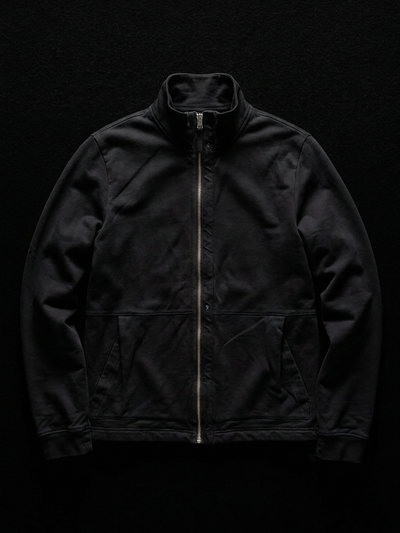
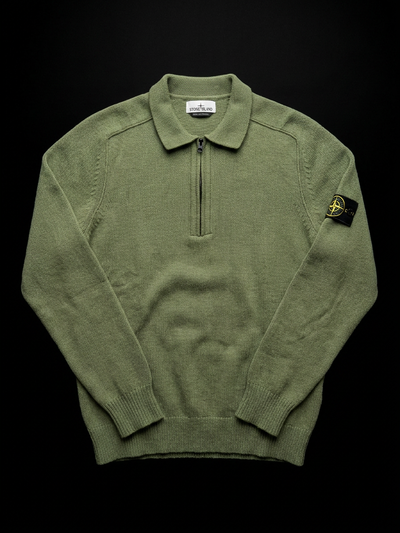
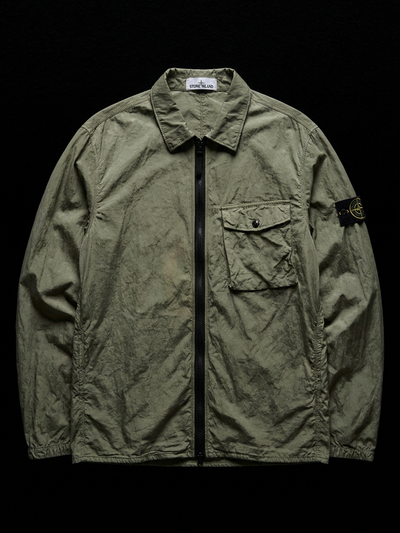
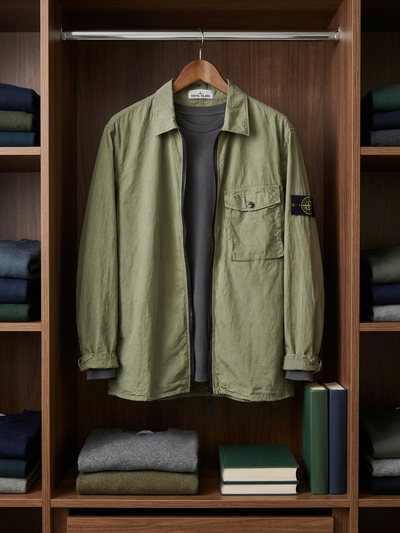
For pieces produced between 1986 and Spring/Summer 2014, the ART code holds the provenance. Found on the white paper care label, this eight- or nine-digit number breaks down systematically:
The first two digits give the year and season. An odd number indicates Autumn/Winter; an even number indicates Spring/Summer. The third and fourth digits identify the brand division, where 15 represents standard Stone Island, 14 represents S.I. Denims, and 18 represents the Junior line. The fifth digit designates the garment type, with 4 denoting a jacket. The remaining digits identify the fabric code and dye lot.
Badges require equal scrutiny. On an authentic standard badge, the compass embroidery should be sharp, with consistent spacing between the letters and yellow needlework. The backing fabric should be a stiff, dense black felt with a horizontal grain. Flip it over: the reverse side of an authentic badge features a distinct black drop-stitch running through the centre of the yellow compass arms. If the back looks as neat and bright as the front, it is a reproduction.
Fair market pricing by condition grade
Stone Island retains value based on model scarcity and fabric integrity rather than age alone. A pristine 2011 David-TC field jacket will easily outprice a two-year-old Crinkle Reps windbreaker.
Grade A (Near-mint): The fabric shows no shine at the cuffs, all original tags and spare buttons are attached, the neck tape is immaculate, and the badge has clean buttonholes. Expect to pay £450 to £700 for a David-TC or O-Ventile piece, and £300 to £450 for Crinkle Reps or Membrana.
Grade B (Light wear): Normal signs of use. Minor fading along the seams, slight patina on the zip pulls, but zero internal membrane degradation. Prices sit around £300 to £450 for heavier technicals, and £200 to £280 for lighter shells.
Grade C (Flawed): Fraying cuffs, faint exterior staining, or a missing original badge. Worth £140 to £220, but only if the shell fabric remains structurally sound. Never pay more than £100 for a jacket with failing seam tape, regardless of the model.
The immediate dealbreakers
Certain flaws are fatal to technical outerwear. Walk away instantly if you notice a vinegar smell when opening the parcel or inspecting the jacket. That scent confirms the polyurethane waterproof backing has hydrolysed. The process is permanent, it smells foul, and it will continue until the coating completely disintegrates.
Avoid jackets that have had their internal wash tags cut out. Sellers often claim this was done for comfort. More often, it was done to hide that the garment is a counterfeit, or to conceal a mismatched ART code from a different model entirely. Without that label, you cannot verify the fabric treatment, season, or authenticity.
Finally, look closely at the main zip. Stone Island relies heavily on Lampo and YKK Vislon hardware. If the insertion pin at the base of the zip is split or coming loose from the fabric tape, replacing it requires unstitching the entire storm flap. On a garment-dyed technical shell, finding an exact thread match and repairing that seam cleanly is almost impossible.
The appeal of Massimo Osti and Carlo Rivetti's outerwear has always been how it bridges laboratory engineering and everyday wear. When you buy properly, a pre-owned Stone Island shell will survive another decade of hard northern weather. Just make sure you are buying the engineering, not the brand's ghost.
Related articles