brand focus
3 minute read
C.P. Company label history — how to tell which era your piece is from
Words by Heather June Coombs
The absence of an RT number on a post-1994 C.P. Company label is a significant red flag.
Dating C.P. Company isn't as straightforward as tracing Stone Island's Green Edge to ART. The brand, under Massimo Osti, had a less rigid approach to internal branding. This means the label itself, while a good indicator, needs to be cross-referenced with other details – hardware, fabric, and construction. Knowing these distinctions is key to understanding a piece's value and its place in the brand's history.
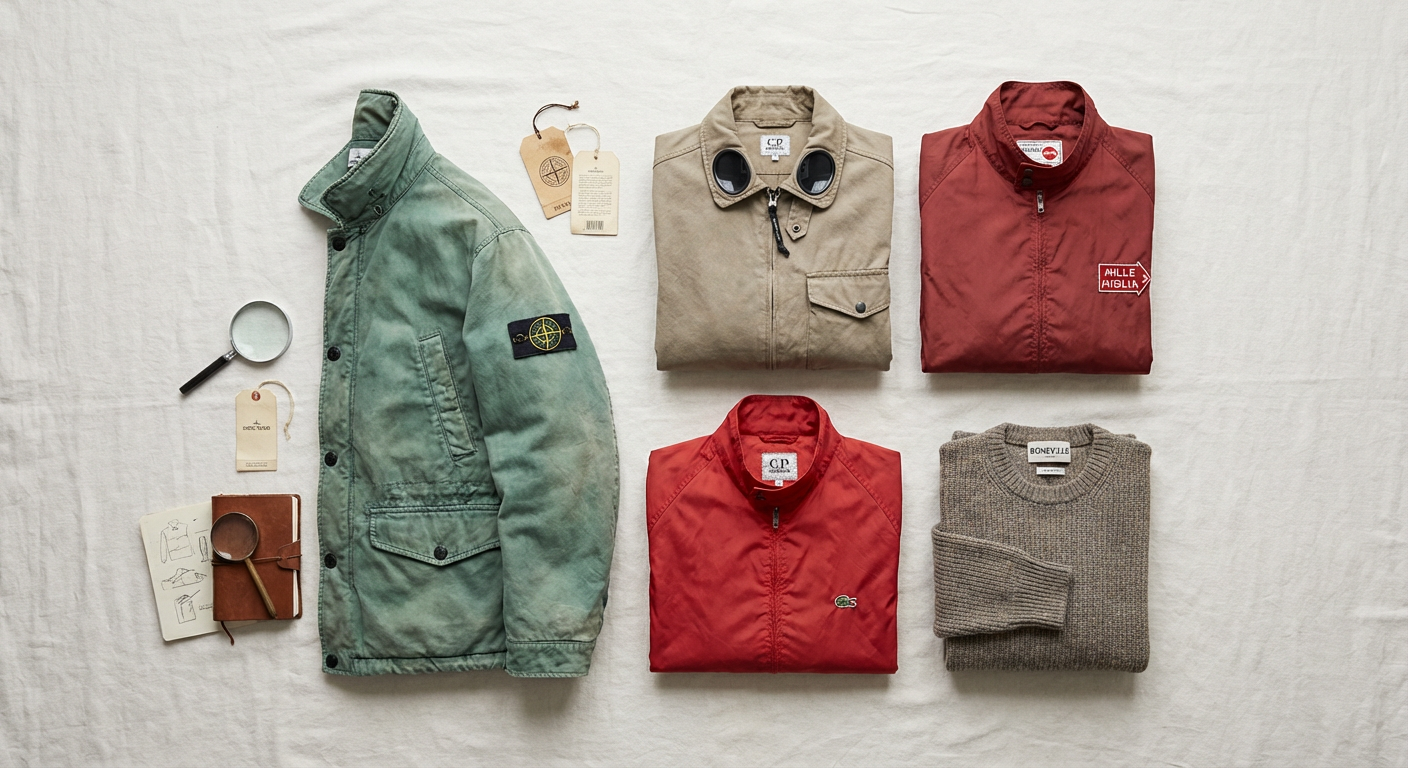
The earliest C.P. Company pieces predate the consistent use of dedicated internal labels. Instead, they often feature a simple fabric content tag, sometimes with 'Chester Perry' woven in, or a generic care label with ‘C.P. Company’ printed small. These items are rare and often signify true Osti design, but authentication relies heavily on construction and materials.
Early Days: Chester Perry & The Initial Osti Vision (mid-70s - early 80s)
Before it was formally C.P. Company, Osti's original venture was Chester Perry. Labels from this period are uncommon and highly prized. They are usually simple, often white or off-white, with "Chester Perry" in a distinctive, almost handwritten script. These pieces are typically heavy on natural fibres – wool, cotton, linen – with innovative dyeing and garment treatments already evident.
Construction here is often robust, focusing on utilitarian design. Think military-inspired field jackets, functional knitwear, and early goggle jackets. Resale value on genuine Chester Perry items is exceptionally high, driven by scarcity and their direct link to Osti’s foundational work. These are collector's items first, wear-every-day garments second.
When you see "Chester Perry" on a label, it’s a strong indicator of early, authentic Osti. But always check the construction. Loose threads, cheap zips, or anachronistic fabric blends are red flags.
The C.P. Company Era: Changing Logos, Consistent Quality (Early 80s - 1994)
As the brand solidified as C.P. Company, the labels became more distinct. You'll find variations, but generally, they feature 'C.P. Company' in a serif font, often with a smaller 'Massimo Osti Design' or 'Designed by Massimo Osti' beneath it up until 1994 when Osti left the company. The fabric content and care instructions are usually on separate tags. Colours vary, but white, navy, or black are common.
This period saw the introduction of many iconic designs: the Mille Miglia jacket, the Explorer jacket, and the development of garment dyeing into an art form. Fabrics like ‘50 Fili’ (cotton/nylon blend) and various treated linens became hallmarks. Quality remained outstanding, with durable hardware (often YKK or Lampo zips), precise stitching, and innovative, complex patterns.
Pieces from this era hold strong resale value, particularly the more iconic outerwear. The 'Massimo Osti Design' inclusion on the label adds a premium for collectors, signifying direct involvement from the founder. Expect robust Italian manufacturing.
Post-Osti: A New Chapter and Specific Tags (1994 - Early 2000s)
After Massimo Osti’s departure in 1994, C.P. Company continued under the Sportswear Company umbrella. Labels during this transitional period often drop the 'Massimo Osti Design' reference. They generally feature 'C.P. Company' prominently, sometimes with a 'Garment Dyed' or 'Tela Stella' marking if applicable. Critically, this is the era when the 'ART. No.' (Article Number) system became more consistently applied, similar to Stone Island.
Shop from this article

The absence of an ART. No. on a post-1994 C.P. Company label is a significant red flag. These numbers, usually found on a small white tag alongside the main label, decode the season, fabric, and item type. Tools exist online to decipher these codes, aiding authentication and dating.
Quality largely remained excellent, with Sportswear Company maintaining high manufacturing standards. Innovation continued, though perhaps with less of the experimental edge of Osti’s earliest years. Resale value is still solid, especially for well-preserved outerwear or unique pieces. The market differentiates between Osti-era and post-Osti, but quality means later pieces are still highly sought after.
Modern Era: Consistent Branding (Early 2000s - Present)
Modern C.P. Company labels are more standardised. They usually feature the 'C.P. Company' logo in a clean, consistent font, often on a black or dark contrasting background. The care label will detail fabric composition and care, and usually, the ART. No. is present, though sometimes subtly placed.
Expect modern fabrics, often incorporating technical elements, and contemporary fits. Construction remains high quality, though perhaps with a shift towards more streamlined production methods compared to the handcrafted feel of the earliest pieces. The goggle hood and lens detail remain central. Resale value is strong for current season or desirable archive re-issues. Authentication is typically straightforward with holographic tags or QR codes for newer items, complementing the ART. No. system.
Understanding these subtle shifts in labelling and construction isn't just for collectors; it provides a deeper appreciation for the brand's timeline and the varying approaches to design and manufacture. Each era tells a specific story about C.P. Company, and the labels are the footnotes.